
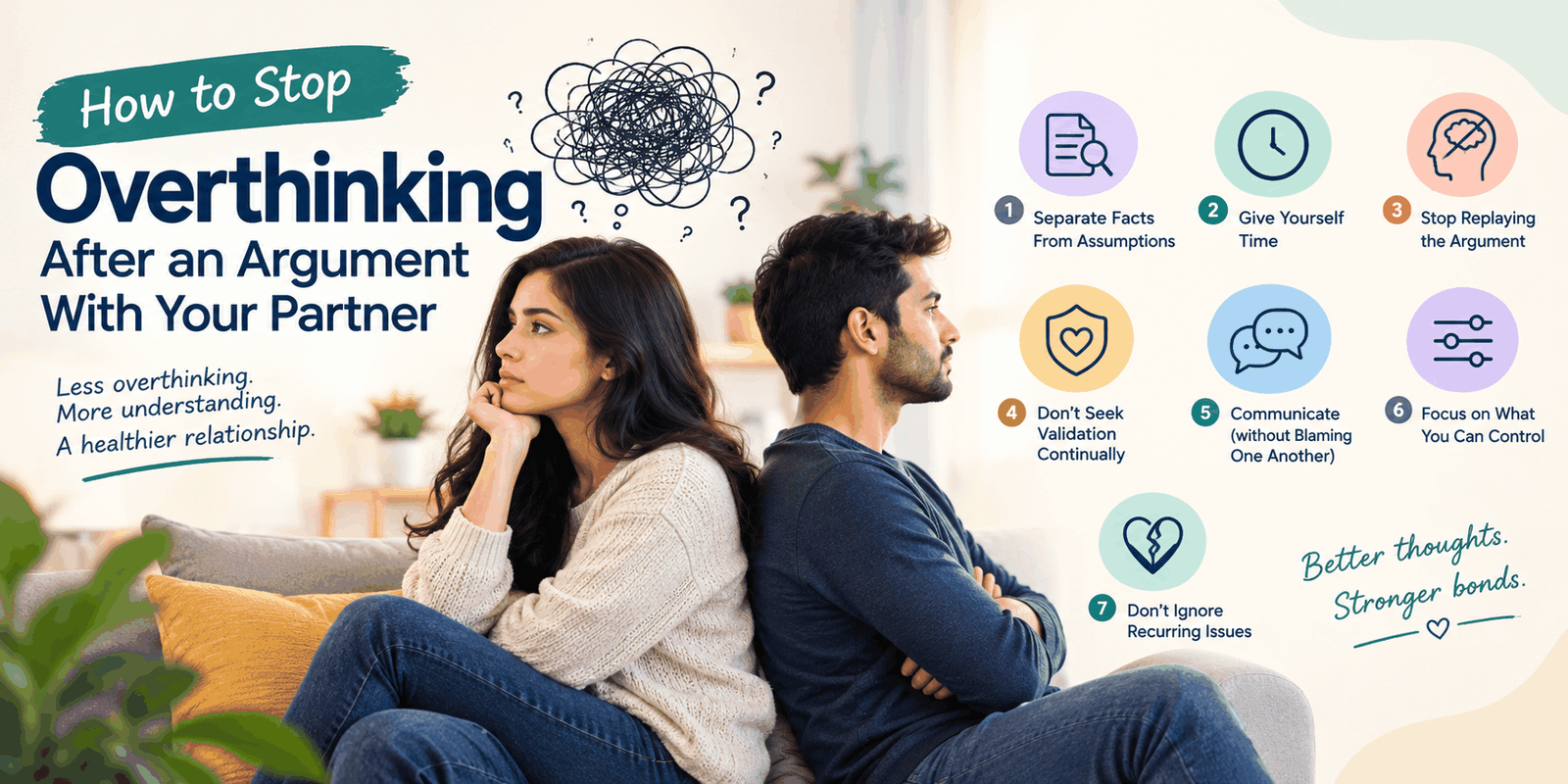
How to Stop Overthinking After an Argument With Your Partner
While conflicts are common in relationships, the feelings that come after the fight can be more challenging to deal with than the issue that triggered it. You can reread the conversation, decipher what your partner said, or get concerned that one argument has influenced their opinion about you. Your mind may still be looking for solutions after you've finished talking.
The first step in ending the cycle of overthinking in a relationship is to make a distinction between what went on and what you think possibly could have gone on. You don't have to test yourself on each problem right away, or figure out every word your partner used. In some cases, it can be helpful to take time to mull over the situation.
1. Separate Facts From Assumptions
When quarreling, it's easy to believe your fears are true. Sometimes, when one person becomes silent, the other could think that it means that one partner isn't interested in it anymore. When they do reply to a message in a short reply, it could be seen as anger or rejection.
But there could be more than one reason for the same kind of behaviour.
Write it down what actually happened and what you believe it means. For example:
The truth: Your partner never solved the problem in the conversation.
Assumption: You are in a bad relationship.
Balanced thought: Disagreement doesn't necessarily mean trouble in the relationship.
This exercise will help you look at the thoughts instead of assuming that all the negative thoughts are true.
2. Give Yourself Time Before Reacting
Overthinking can be exacerbated by the need to solve all problems instantly. You may send text messages to your partner again and again, ask the same questions or attempt to re-engage in a conversation until you are both prepared to talk.
Rather, give yourself some time to rest!
Walk around, take a drink of water, listen to relaxing music or go to another room. When you feel that you are feeling emotional, delay any significant conversations until you are better able to articulate your emotions.
Breaks are not an excuse to avoid the issue. It provides both partners with the chance to take a more patient approach to it.
Share information about space requirements if needed. You could send a straightforward message stating that you need to relax and would like to discuss the issue later and avoid any unnecessary confusion.
3. Stop Replaying the Argument
Resummarizing the argument can be “problem solving,” but continually reanalysing the same conversation is unlikely to yield new solutions. Rather, it can lead to feelings of frustration, guilt or anxiety.
If you find yourself repeating words, then turn it back around nicely.
So, ask yourself these 3 questions:
● What is new that I can learn by thinking about this?
● What can I do now?
● Does thinking about this conversation help me, or does it hurt me?
If nothing is going to change, accept the break.
Another option is to allocate a particular time to consider the disagreement. After that, if time allows, go back to some activity you need to be focused on. The purpose is not to eliminate all thoughts but to get rid of one argument from taking up the whole day.
4. Don't seek validation continually
Asking your partner for reassurance is not an unhealthy occurrence. It may provide you with some sense of being validated and emotionally connected. If the concern goes unresolved, it may only be temporarily alleviated by repeated questions about whether things are ok or not.
For instance, perhaps the same question several times will give you a quiet moment, but another unanswered enquiry or the tone of voice may lead to the same fear.
Rather, look for what you truly need. Apology, clarification, love or discussion about what happened?
If you know you need it, tell them outright, don't keep trying to detect their sentiments. Having confidence in your own ability to manage uncertainty can help alleviate the need for constant reassurance.
5. Communicate (without blaming one another)
If the disagreement has not been resolved, then sometimes it continues to be overthought. You might be trying to figure out what your partner wants to do as he didn't get to explain his feelings.
Once you've both calmed down, discuss the matter again, but from a non-confrontational perspective.
Avoid making accusations, use statements that describe what you experienced. You might say, for instance, “I don't want to seem rude, but when we stopped talking like that I felt hurt, and I'd like us to get to know each other better.”
Let your partner talk about his or her experience as well. Good dialogue does not presuppose shared agreement between two parties. It demands that they listen to each other, respect the other's emotions and strive to arrive at a mutually agreeable solution.
6. Focus on What You Can Control
You can't stop your partner from reacting in any way or guarantee that conflicts won't occur, or foretell the outcome of any discussion.
But you can choose to communicate - you can choose to take responsibility for what you do and how you take care of yourself after.
If you did something hurtful, try to sincerely apologize. If your partner has breached a boundary, consider how you would like to discuss the breach. If it was due to misunderstanding, find a chance to clarify.
If you take action, you have a purpose in your mind rather than going over the same scenario again and again.
7. Don't Ignore Recurring Relationship Issues
Not all concerns come from being overthinking. If there is a consistent pattern of disrespect, manipulation, threatening, controlling, and/or repeated violations of boundaries, your discomfort may be a true issue.
Don't just ignore your emotions, look at the overall pattern. Think about how both partners are involved, if disagreements result in positive shifts and if you are comfortable sharing your feelings with the partner.
Even in healthy relationships, there are conflicts that can occur, but those involved should be able to express themselves in a way that is free of fear and intimidation.
Conclusion
It is not about suppressing feelings or denying arguments in a relationship, it's about learning to let go of overthinking. To react to emotions rather than fear taking over your thoughts.
Allocate time for: Calming down, challenging assumptions, communicating needs and focusing on practical solutions. Above all, keep in mind that disagreement isn't necessarily a problem with your relationship. The key is what both parties do when in conflict, and what they do when it's over.It's what they do in conflict, and what they do afterwards, that matters.