
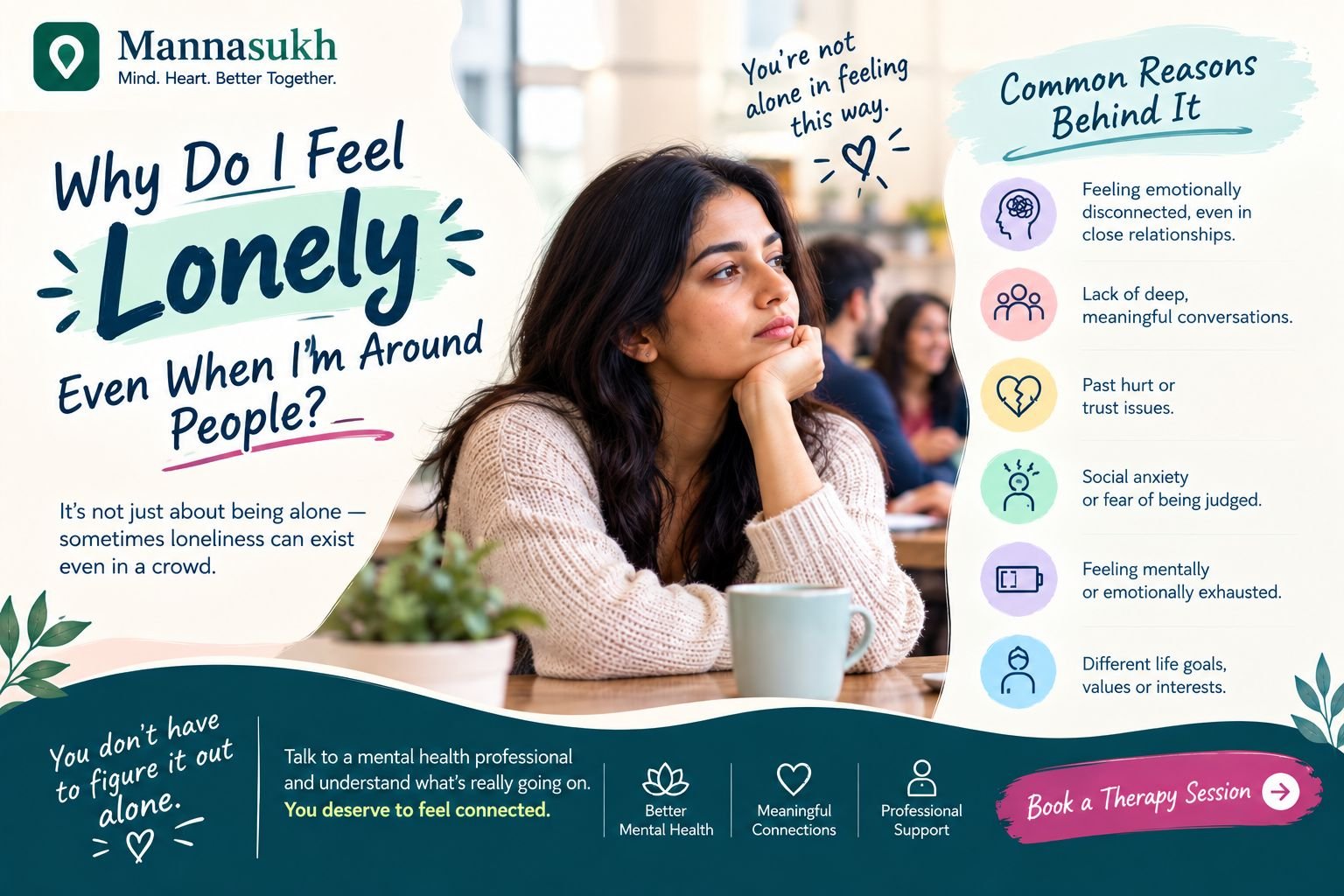
Why do I feel lonely even when I’m around people?
Have you ever been in a room with friends, a family reunion or a full day at work and come home with a persistent sense of emptiness? Maybe you have laughed at conversations, answered a message or gone to a social gathering, but you know that you have felt like no one really gets you.
If you've ever found yourself searching, "Why do I feel lonely even when I'm around people?", you're not alone. This is one of the most frequently asked questions by clients of mental health professionals. The mind doesn't always think in terms of isolation, but of the absence of companionship. Loneliness is not a matter of isolation, as the mind sees it, but of lack of companionship. Loneliness is not a matter of the number of people around one; it's a matter of the quality of emotional connection.
Even with hundreds of social media followers, a loving family, and supportive colleagues, I still feel lonely all the time. On the other hand, a single person could be extremely connected and emotionally satisfied.
Loneliness is more about feeling emotionally isolated, misunderstood, disconnected or unable to be your true self with others, as a psychologist would describe it.
But the positive thing is that emotional loneliness isn't a permanent condition. If you know you've got a problem, you've taken the first step to solving it. This detailed guide will show you the psychology of loneliness, why it can even occur in crowded spaces, how it impacts mental and physical wellbeing, action steps to overcome loneliness, and when professional therapy might be beneficial.
What is emotional loneliness?
The feeling of being alone is different from the feeling of being lonely, so psychologists differentiate the two. Alone does not mean lonely; it just means there are no other people around. People like solitude because they feel they are able to rest, be creative and think about themselves.
Loneliness is an emotional experience, though. It's when, despite the presence of others, you are not feeling connected to anyone.
In psychology, loneliness is the feeling of not having the companionship you want.
For example, you may:
Have lots of friends, but no real friends.
Talk to coworkers daily, but not about one's true feelings.
Feel loved and think you are not loved.
Be in a romantic relationship but still feel emotionally distant.
This is the emotional void that leads to loneliness.
Have friends and family but feel lonely? Here's Why
There is not a single explanation. Rather, psychologists have noted that emotional loneliness can arise at the intersection of emotional, psychological, social, and biological conditions.
Here are some of the more frequent ones.
1. You Feel Emotionally Unseen
The quality of your relationships is not the best predictor of loneliness; it's whether or not you feel emotionally understood. There may be people around you who care about you, but if you always feel nobody understands your fears, dreams, struggles or feelings, then loneliness is bound to come along.
It's not uncommon for people to become masters at hiding their true emotions. They smile, make jokes, work, and chat with others, but they are silently feeling emotional pain.
You can feel invisible when your only known to people is the “public version” of you.
2. Emotional shallowness in your Relationships
Not all relationships nourish emotional needs. A few relationships are restricted to:
Work discussions
Household responsibilities
Daily routines
Small talk
Social media interactions
These discussions help to keep relationships alive, but they don't necessarily lead to emotional closeness.
Humans require vulnerability-centred conversations, trustful, empathetic and accepting. Loneliness can never be overcome without emotional depth.
3. You're Constantly Wearing a Mask
It is believed by many that they need to be other people to fit in.
They suppress:
Anxiety
Sadness
Anger
Insecurity
Past trauma
Personal struggles
This is known as emotional masking in psychologists' terms.
The more you try to be someone you're not, the lonelier you can end up being because people are relating to the person you're pretending to be, not the YOU you are.
4. Past Trauma Makes Trust Difficult
Growing up in a neglectful, emotionally abusive, bullying, betraying, abandoning or toxic environment with your parents or caregivers can have a big impact on your future relationships. Though those who are trustworthy join your life, your brain might still feel the need to reject them.
You put distance between yourself and your emotions as a protective measure. This means that they have less chance of being vulnerable, but they are also more likely to feel lonely.
5. Social Media gives the impression of connection
Communication has become easier than ever with the help of technology.
However, numerous studies have indicated that overuse of social media can be associated with greater loneliness.
Why?
We see it in the carefully curated lives we scroll through; there's a lot of room for unhealthy comparisons.
You can start to believe:
All the others have close friends.
Everyone is happier.
Everyone belongs somewhere.
In fact, many of these same people could be feeling the same sense of loneliness.
Real-life interactions cannot be completely surpassed by digital interactions.
6. You don't feel safe with your emotions
Emotional safety is a key building block of healthy relationships.
If you have experienced criticism, ignore, dismissal, or judgment for expressing emotions, you may decide not to share any more.
Instead of saying:
"I'm struggling."
You can automatically respond:
"I'm fine."
With time, emotional repression develops into emotional separation from others.
7. May be depressed or anxious
Sometimes, loneliness can last longer than it should and be accompanied by mental health issues like:
Depression
Social anxiety
Generalized anxiety disorder
Complex trauma
Low self-esteem
When a person is feeling depressed, it can make them feel that others don't like them, that no one cares for them, that no one is interested in them, that they are unwanted, or that they are alone.
Likewise, interactions with others may become tiring when they feel anxious, and they might feel longing for social interaction yet have the tendency to stay away from it.
8. Major Life Transitions Can Trigger Loneliness
Any change, positive or negative, can bring about emotional loneliness.
Examples include:
Relocating to a new town
Starting college
Changing careers
Becoming a parent
Divorce
Retirement
Losing a loved one
These transitions frequently lead to loss of support systems, and take time to establish new, meaningful relationships.
9. You have high emotional needs which are not being met
Then there are those that may seek greater emotional connection than others.
There is no lack of strength here.
If you have emotional needs that fit this category:
Meaningful conversations
Genuine empathy
Quality time
Emotional validation
10. You've Lost Connection With Yourself
One of the biggest reasons for feeling lonely is a lack of connection with yourself.
Many people forget to connect with themselves, forget expectations, forget to enjoy:
Emotions
Personal values
Interests
Identity
It is difficult to have relationships with other people that are meaningful without self-connection.
Signs That You May Be Allowing Your Loneliness To Affect Your Mental Health
Loneliness is a normal part of life.
But long periods of isolation can start to take a toll on your emotional health.
Common signs include:
Feeling emotionally numb
Loss of motivation
Difficulty enjoying activities
Increased anxiety
Persistent sadness
Low self-esteem
Constant overthinking
Difficulty trusting others
Social withdrawal
Sleep disturbances
Feeling like nobody truly knows you
Emotional exhaustion
Negative self-talk
Hopelessness about future relationships
These symptoms are likely to persist for weeks or months, and if they disrupt your daily life, it may be helpful to seek professional help.
The Hidden Effects of Chronic Loneliness
Loneliness can impact mood as well.
Evidence indicates that prolonged loneliness could have an impact on:
Stress hormone levels
Sleep quality
Immune system functioning
Cardiovascular health
Cognitive performance
Emotional regulation
Loneliness also has been linked to an increased risk of depression, anxiety disorders, and burnout, and has a detrimental effect on long-term health.
That's why it is important to mental health professionals to intervene early instead of shrugging off "just a phase" of loneliness.
How to Overcome Emotional Loneliness
Loneliness is not in the number of people around you! It's all about relationships, the kind of relationships you have with others and with yourself.
1. Start by Acknowledging Your Feelings
Many people blame themselves for feeling lonely despite having family and/or friends. Do not assume that you are mistaken for feeling lonely because you do not have any other friends to go to. Do not label yourself as wrong if you feel lonely, because you do not have other friends to turn to. Allowing ourselves to experience our emotions without judgement is the starting point to healing.
2. Concentrate on quality, not quantity
Lots of people have a large social circle but don't have emotional fulfillment. Get to know people where you are cared for, accepted, and respected; don't try to add people to your life.
3. Practise vulnerability in safe relationships
As time goes on and individuals slowly share their true thoughts and feelings, healthy emotional intimacy develops. Even sharing a bit can help to deepen emotional connections and decrease loneliness.
4. Reconnect With Yourself
Take time to become aware of your own feelings, interests, values and needs. Journaling, mindfulness, hobbies or quiet time can help to strengthen one's relationship with oneself, which can help to strengthen the relationship with others.
5. Reduce Passive Social Media Consumption
If feeling inadequate or feeling like you're not included when scrolling through social media is a problem, try to spend less time on your phone and do something instead, such as a real conversation or activity together or getting involved in the community.
6. Join Communities With Shared Interests
Good relationships can arise organically when people have shared objectives or interests. Join book clubs, fitness groups, volunteer groups, hobby classes, or professional groups in which true interaction is encouraged.
7. Develop healthy communication skills
Sometimes loneliness continues because of difficulties in expressing feelings, or seeking assistance. Learning how to communicate, establish boundaries and actively listen can make a big difference in enhancing the quality of a relationship.
8. Take care of your mental health
Emotional connection can feel safer and more fulfilling when it is rooted in addressing those underlying emotions such as anxiety, depression, trauma, and low self-esteem.
When to seek therapy?
Many people think that therapy is only when it's an emergency, but therapy is helpful for people who just want to have a better relationship and emotional well-being.
If you're feeling the following symptoms, think about trying therapy:
This is a condition that lasts for many months of loneliness.
Lacks emotional intimacy with others in close relationships.
It's difficult for you to believe in people.
Your experiences in childhood continue to impact your relationships.
You feel lonely and have depression or anxiety.
You try to stay away from social interactions, but you want to be connected.
Emotional overload/hopelessness.
A trained psychologist is able to offer you a safe, confidential setting to delve into your feelings, discover relationship patterns and find healthier approaches to connecting with yourself and others.
How Therapy Can Help With Loneliness
Therapy isn't about giving you advice or "socializing more. Instead, it will help to reveal the emotional patterns that are responsible for your loneliness.
A psychologist can assist you to:
Determine the causes of emotional loneliness.
Work through trauma and/or grief.
Dispute thoughts and feelings about self and relationships.
Develop emotional awareness and self-compassion.
Develop more effective communication skills and relationships.
Become more confident at making meaningful connections.
Minimize symptoms of anxiety and depression that can lead to isolation. Therapy may help you build genuine connections, instead of ones that are based on fear, and ultimately, a sense of belonging can be developed.
Frequently Asked Questions (FAQs)
Is it normal to feel lonely even when I'm surrounded by people?
Yes. Emotional loneliness is common and frequently experienced when you feel undervalued, emotionally unsupported and not connected to others. Loneliness has nothing to do with how many people are around you and is more about the quality of your relationships.
Can loneliness be a sign of depression?
Yes. Unfortunately, loneliness can exacerbate and be a symptom of depression. If loneliness is combined with continued sadness, loss of interest in activities, fatigue, disturbed sleep or eating patterns, or a sense of hopelessness, it's essential to receive a professional evaluation of mental health.
What causes loneliness in a relationship?
Loneliness isn't a sign that you're in a relationship. Although there are many reasons why you might feel lonely when you're in a relationship, emotional distance, poor communication, unresolved conflicts, unmet emotional needs, and lack of intimacy are just a few of the reasons.
Is social media contributing to loneliness?
It can. Although social media can keep people connected, overuse or passive use can have negative effects, such as making comparisons with others to make oneself feel more lonely, less face-to-face with others, and having unrealistic expectations of others' lives.
Is there any therapy that is effective for loneliness?
Yes. Therapy is used to help to determine the emotional, psychological, and relational elements that is causing feelings of loneliness. It also offers practical solutions to enhancing self-awareness, communication, emotional strength and relationship dynamics.
Is it necessary to consult a psychologist?
If loneliness is experienced for weeks or months, it interferes with functioning, with interpersonal relationships, and/or is accompanied by anxiety, depression or hopelessness, then it is advisable to consult a qualified psychologist.
Does being lonely have an impact on physical health?
Yes. Chronic loneliness has been found to raise stress, interfere with sleep, impair immune function and be a factor in chronic health issues. Solving loneliness is crucial for mental and physical health.
What is the time period of emotional loneliness?
There is no definite time. The recovery process depends on the reasons for your addiction, you will need to be committed to self-reflection and change, the support system that you have, and whether you are receiving professional assistance. People start to make a difference in their lives with regular therapy sessions and purposeful relationship building.
Final Thoughts
It is a confusing and painful experience to feel lonely in a crowd – but it doesn't mean something's wrong with you. It is frequently a sign of a lack of authentic love instead of not having anyone in your life. To help heal from physical isolation and emotional loneliness, it's best to distinguish between the two.
Keep in mind, loneliness is not a personal problem; it is a very human problem that can happen because of a transition in life, past trauma, mental health issues or lack of deep connections in relationships. Self-awareness, positive relationships and appropriate guidance can help foster genuine relationships and a sense of belonging.
Take the First Step Toward Feeling Connected Again
If you find yourself feeling lonely, this is a feeling that has become consistent, it has affected your relationships, or you feel it is combined with anxiety, depression or emotional fatigue, then you don't have to do it alone.
Schedule a therapy appointment with a licensed mental health therapist and start to embark on a path towards emotional wellness. Seek out a therapist who is licensed by the RCI and who has a strong background in psychology or mental health, employs evidence-based therapy, and is able to offer a safe, confidential environment for healing.
Sometimes, a single impactful conversation can start a more connected, healthier life.